

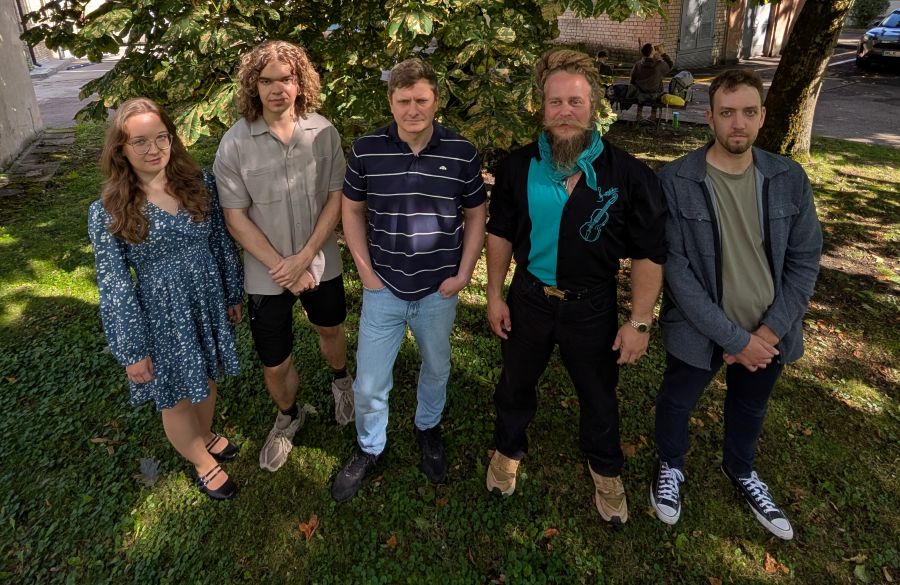
From the left: Gabija Sergejevaitė, Nojus Radzevičius, Prof. Dr. Edvinas Orentas, Jonas Žurauskas, Paulius Vaickūnas. (Photo from personal archive)
Finding a promising drug candidate often requires chemists to synthesise hundreds of slightly different versions of the same molecule. Yet each new analogue typically demands its own synthetic route, making the process slow, labour-intensive and expensive. Researchers at the Faculty of Chemistry and Geosciences of Vilnius University have now developed a new chemical method that could significantly simplify this work by allowing many different molecular variants to be generated from a single intermediate.
Published in the Journal of the American Chemical Society (JACS), the study presents the first general photoredox method for introducing a versatile one-carbon (C1) linking fragment directly into simple aromatic compounds. Once installed, this fragment can be readily transformed into a wide range of functional groups, giving chemists a flexible starting point for creating diverse molecules without redesigning the synthesis from scratch. The study was led by PhD student Jonas Žurauskas under the supervision of Professor Edvinas Orentas, in collaboration with PhD student Nojus Radzevičius and master student colleagues Paulius Vaickūnas ir Gabija Sergejevaitė at Vilnius University.
A Universal Chemical "Adapter"
In medicinal chemistry, even the smallest structural modification can determine whether a compound becomes an effective drug candidate or fails altogether. Because researchers often need to prepare dozens or even hundreds of analogues before identifying the most promising one, methods that simplify this process can considerably accelerate early-stage drug discovery.
The key innovation is a universal intermediate compound that functions as a chemical "adapter". "Previously, each analogue required its own synthesis route. Now we can introduce a single intermediate in one step and use it to prepare many different molecules," explains Žurauskas.
He compares the approach to mounting a universal wall bracket: "Instead of drilling a new hole and finding a different fastening system every time, you install one holder that allows different objects to be attached later. Our method works in much the same way: first we introduce a universal intermediate, which can then be converted into many different molecular structures."
To demonstrate that the method is practical rather than merely theoretical, the researchers successfully applied it to several widely used pharmaceutical compounds, including ibuprofen, naproxen, a sildenafil analog, cannabinoids, tadalafil derivatives, estrone, and others. The experiments showed that the reaction is compatible with functional groups commonly found in drug molecules, which often interfere with more sensitive synthetic methods.
According to the researchers, this suggests that the approach could be broadly applicable for modifying pharmaceutical and other biologically active molecules, enabling chemists to prepare new analogues and systematically explore their properties.
Using Light to Drive the Reaction
The method is based on photoredox catalysis, where visible light provides the energy needed to initiate the reaction. Light activates a photocatalyst, which transfers an electron to a newly developed reagent known as a methylenedipyridinium salt (DiPyM). This generates a highly reactive intermediate that attaches to the aromatic molecule before the catalyst returns to its original state and the final product is formed.
Because the catalyst is regenerated during the process, only a small amount is required (1 mol%), and the reaction proceeds without additional oxidants or reductants. "It is precisely these mild, visible-light-driven conditions that allow us to achieve a level of selectivity that is difficult to obtain using conventional reactions based on high temperatures or strongly acidic conditions," says Žurauskas.
The researchers note that this is the first general photoredox strategy for directly introducing a C1 linking group into unactivated arenes, providing synthetic chemists with a new and broadly applicable transformation.
Potential Applications Beyond Drug Discovery
The team sees several areas where the method could prove valuable. One is medicinal chemistry, where it could help researchers generate and evaluate new drug candidates more efficiently. Another is the development of molecules capable of targeting cell mitochondria, an important area in drug delivery and biomedical imaging. The approach could also find applications in materials science, where rapidly preparing structurally diverse molecules is equally valuable.
Although the work represents a fundamental advance in synthetic chemistry, the researchers have already demonstrated that the method works across a broad range of compounds, can be performed on a larger scale, and has been experimentally validated. Rather than serving as a proof of concept alone, it offers a practical synthetic tool that other researchers can immediately begin exploring in medicinal chemistry, chemical biology and materials research.
From Idea to JACS – in Nine Months
This is the first paper by PhD student Jonas Žurauskas published during his doctoral studies in one of the world's most prestigious chemistry journals – the Journal of the American Chemical Society (JACS). Nine months passed from the initial idea to the acceptance of the publication.
The researcher admits that he expected a high-level result from the very first experiments, and the paper's acceptance by JACS only confirmed his initial intuition. It is also interesting that the main reagent of the reaction was described in the chemistry literature many years ago, yet no one had previously used it in quite this way. This serves as a reminder that significant discoveries sometimes lie not in creating a new substance, but in the ability to look at something already known from a different angle.
For the researcher, this publication means more than a personal achievement – it is an opportunity to show that high-level photochemistry research is being carried out in Lithuania.
“When I came here to study for my PhD, this field practically did not exist in Lithuania – it had to be brought in and built up from scratch,” he says. “The JACS publication symbolically confirms that ambitious, internationally significant scientific research can be born and grow not only in the major Western centers of science, but in Lithuania as well.”
Team without whom this result would not exist
J. Žurauskas emphasizes that this discovery is not the work of one person, but the result of a strong team's effort. Doctoral student Nojus Radzevičius and master's students Paulius Vaickūnas and Gabija Sergejevaitė contributed to the research. Each of them showed the diligence and scientific curiosity without which such a result could not have been achieved. "Nojus developed the post-modifications of the intermediate compound – he did this extremely efficiently and confidently. He has an exceptionally high level of experimental mastery in the lab, which is rarely encountered. Paulius showed a remarkable ability to solve complex synthetic problems and never gave up, even when experiments didn't initially work as expected. And Gabija's special contribution was purifying complex, intricate reaction mixtures using automated purification systems. Her precision and thoroughness in this area were extremely important, especially when working with sensitive intermediate compounds that had to be purified without loss. We are also grateful to doctoral student Simonas Balčiūnas for his help working with the purification systems and for valuable discussions," says J. Žurauskas. "All three are exceptionally talented and hardworking young scientists, and I am proud to be able to work with them," says J. Žurauskas.
All the article's authors are Lithuanians working at Vilnius University. "This is a rare case in publications of international standing – such work usually emerges from large, multinational research groups. We managed to achieve this result with a team assembled entirely in Lithuania, and that is personally very important to me," the doctoral student shares.
According to the researcher himself, the greatest influence on the study came from his academic supervisor, Prof. Dr. Edvinas Orentas. "Edvinas is the greatest academic guiding light, not only for me but for all of us. He has an exceptional scientific mind – the ability to see where a truly significant chemical problem lies, before it becomes visible to others," says the doctoral student. J. Žurauskas adds that he is grateful for the academic freedom the professor gives the whole team: "That kind of freedom – to formulate ideas independently, take risks with them, and develop them – is exceptional and rarely found in academia. It's exactly what allowed this project to grow into what it is today." According to the doctoral student, this kind of scientific environment at the Faculty of Chemistry and Geosciences at Vilnius University made it possible, in a relatively short time, to develop a research direction that had practically not existed in Lithuania before.