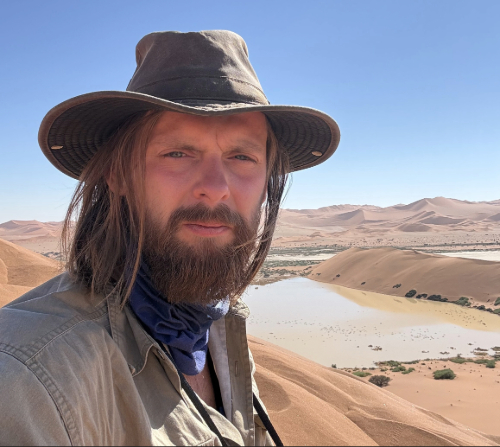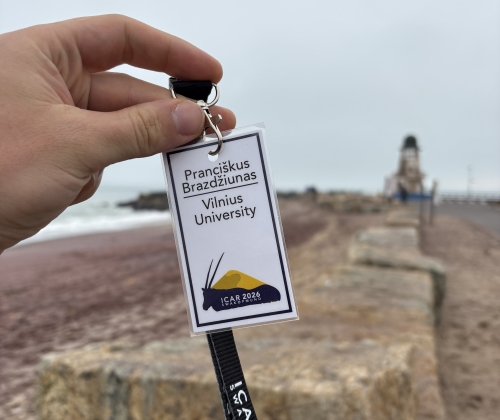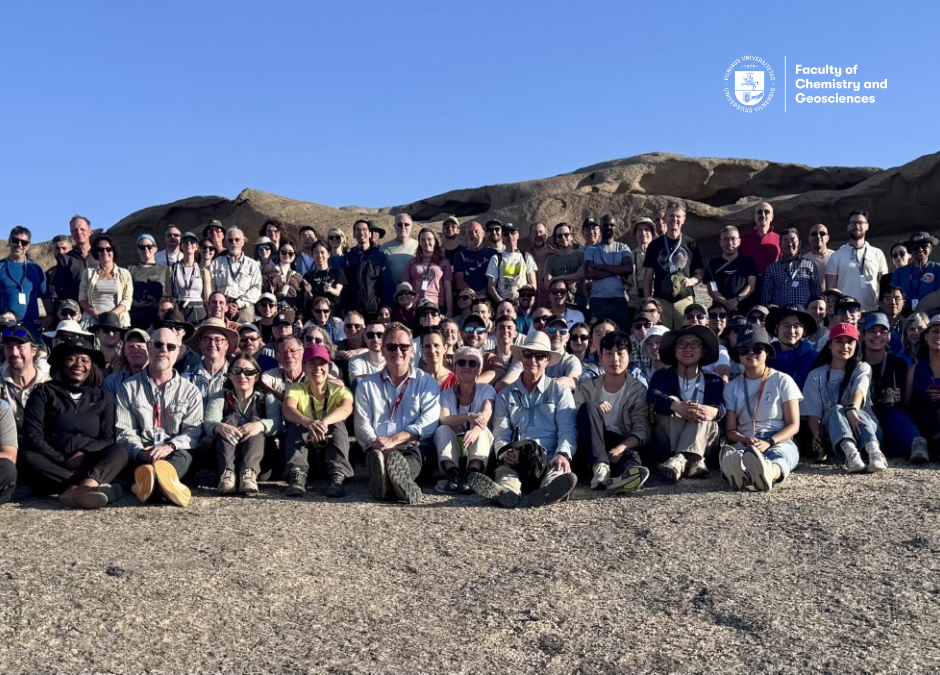
In July, Pranciškus Brazdžiūnas, a PhD student at the VU FCHG Institute of Geosciences, took part in the ICAR2026 (International Conference on Aeolian Research) held in Swakopmund, Namibia. This conference, organized every three years in a different part of the world, is hosted by the International Society for Aeolian Research (ISAR) together with the University of Oxford. It brings together scientists studying wind-blown sand, related processes, and landform development.
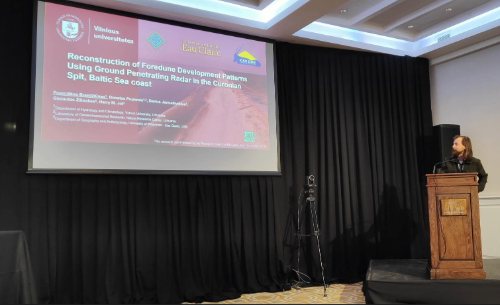
Our faculty's PhD student gave a presentation titled "Reconstruction of Foredune Development Patterns Using Ground Penetrating Radar in the Curonian Spit, Baltic Sea Coast." His supervisor is Prof. Donatas Pupienis. The research was carried out together with scientists from the Nature Research Centre and the University of Wisconsin (USA).
The latest research presented at the conference sparked considerable discussion – wind-formed dunes still raise many questions. Although at first glance these processes may seem well studied, new methods keep revealing further nuances that shape dune development and the influence of wind regimes on them. The context of climate change is especially significant, as shifting wind and moisture regimes are reflected in dune evolution as well.
"It was interesting to hear about the changes scientists are observing in different parts of the world and the methods they use in their research. It is also interesting that these processes are studied not only on planet Earth, but on Mars as well," shares the PhD student.
According to P. Brazdžiūnas, most of the conference presentations focused on reconstructing past conditions based on the developmental history of dunes. This is an area he plans to continue working in going forward. There is currently not much research of this kind in Lithuania, so it's especially important to engage with foreign scientists, gain experience, and build new connections. During the conference, he got to know scientists from Poland, with whom he is now planning to develop joint research projects.
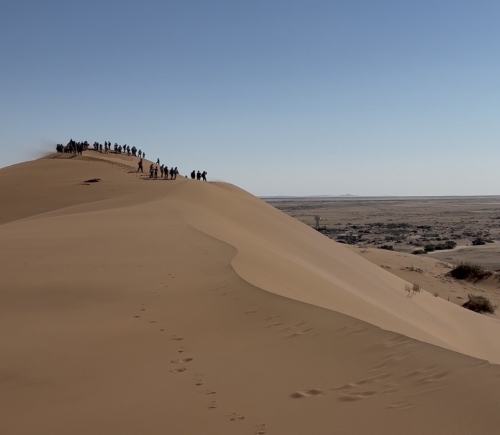
The conference also included a field trip to the Gobabeb Research Institute, located in the middle of the Namibian desert.
The funding for the academic trip was provided by the Research Council of Lithuania.