

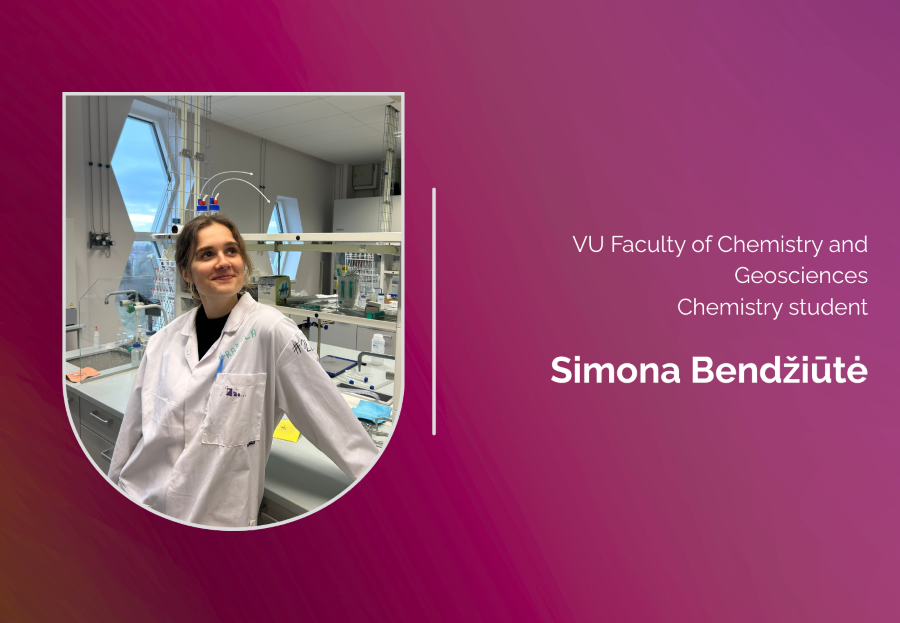
The Smart Internship for Vilnius University (VU) students is a space for new experiences and professional growth. Solving real-world problems faced by companies and institutions allows students to gain practical skills and broaden their horizons. In this interview, VU student Simona shares her experience: what an internship at the Ministry of Transport and Communications and the FCIS looks like, why it is worth stepping out of your comfort zone, and the value of connecting with students from other fields of study.
When was the first time you participated in the Smart Internship? How many times have you participated?
I participated three times. The very first time was a long time ago, during the quarantine period that everyone seems to have forgotten by now. Everything happened remotely then. We only met in person when our team was awarded diplomas and little gifts. All of this takes me back to the spring of 2021, when we solved a challenge together with the work safety equipment store "DSP Plius." The problem they raised was: "How to encourage customers to use the online store?" It was very fun to work in an interdisciplinary team back then. Well, it was also my first time in such a project in general – a lot of new impressions, acquaintances, and knowledge.
After all these good emotions, I tried again in 2022. This year, we solved a challenge with a somewhat more serious institution – the Ministry of Transport and Communications of the Republic of Lithuania. They needed students' creativity for a rather complex issue: "How to modernize the concept of the universal postal service in order to meet modern user needs?" This internship was literally a challenge – we had to read complex documents, current national laws, search for and analyze the foreign experiences, consumer rights and opportunities. We mostly analyzed postal issues and had the opportunity to go on a tour to the Mail Sorting Department here in Vilnius. However, despite the difficulties in these foreign fields that I hadn't encountered before, it was very interesting to challenge myself to learn things from the ground up. Such specific knowledge sometimes comes in handy in the strangest moments of life.
During my master's studies, when I thought my university student life was almost reaching the finish line, I realized I had to do it one more time. So, in 2025, I became a Smart Internship participant in a team that collaborated with the FCIS. I really liked this challenge: "Is delayed justice always just?" It's a very philosophical topic, which I like, but we had to delve deep into law and legislation, which is completely foreign to me. Thanks to the team, everything was simpler, easier, and more interesting. We had live meetings with representatives of the institution at the FCIS office. It is a strange feeling to participate in the activities of such a famous and well-known institution.
Let's go back to the very first Smart Internship. How did you find out about such an opportunity, and what encouraged you to participate?
I always participate in many activities in various places at the same time. When the entire world was drowned in the isolating mood of quarantine, I, just like everyone else, spent my time at home, and I really dislike doing nothing at all. It was my second year, and I thought – I should take an interest in everything happening at the university, especially in our faculty. On that note, I read the VU newsletter and found out what the Smart Internship was. Why not try it? So, thanks to the newsletter, boredom, and the search for adventure, I learned about such a fun extracurricular activity.
What was teamwork like, and how did it go working with students from different fields of study?
All three times, both the teams and the feeling of being in them were very different. The first year, when I was a "green" student, everything seemed very new, and I got into a team that also had older students. I really liked listening to their stories. Maybe it was the influence of the quarantine – everyone felt united and missed contact, companionship, wanted to do everything, had a lot of inspiration, and, most importantly, free time. The impression of that first internship remained indelible, and I only have the fondest memories of the time. Here lies the charm of first times, when you dive headfirst into somewhere you've never been, and it turns out those fears aren't such monsters after all.
I remember the second time a bit less. The team wasn't as united, and the challenge posed a lot of difficulties. Nevertheless, each team member showed interest in their respective roles, so we achieved an excellent result, which we presented to the challenge organizers. We made new friends with whom we shared the same experience and difficulties. Connecting with others especially helps to overcome various obstacles, so such lessons come in handy every day.
In the third year, I was the oldest on the team! It's fun to remember: in the first year, I was gaining experience, and now, in my final master's year, I was sharing it. It's a strange and special feeling to compare this whole journey, how it changed, how much I've grown, and how others are still growing.
It's a bit hard to communicate with students from different study fields regarding work at first because everyone has very different perceptions: maybe some are more creative and have, I would say, crazy ideas, while others are more rational. When everyone is just put into one group, and everyone offers interesting ideas from their own perspective, coordinating them is extremely difficult, sometimes even funny (in a good way), but the results are always great. The result is important and will be there regardless, but the process leading up to it is even more important – it must allow you to enjoy it, give you space to make mistakes and learn, and get to know people.
How does communication with the organization's representative happen?
In the first week, there is a meeting with the organization's representative, during which we get to know each other, discuss the challenge, and share expectations. Later, meetings usually happen every two weeks. Sometimes they assign homework on what to analyze and look into, or on the contrary, we discuss what we have found and understood.
There is certainly no constant pressure from the organization's representatives, but you always feel the responsibility that you need to keep them informed and tell them how it's going. There were also cases when we met even less frequently – one time it was once a month. It all depends on how well you manage to realize the ideas and how much time you can allocate. Most often, we meet with the organization's representatives in person, not remotely.
What skills and knowledge did you gain doing this internship? How did it differ from regular professional practice or work experience?
The entire Smart Internship is based on the "Design Thinking" method, which is very popular when developing new business ideas or looking for solutions to real-world problems in companies. Even now, I am participating in another project that is based on the same method while creating a startup. This is quite important, as the knowledge gained serves perfectly when creating, planning, and organizing new projects or striving to realize ideas. Being in an interdisciplinary team, proposing my ideas, voicing them, and actually implementing them appeals to me a lot. I admire and always enjoy the process, which is so colorful every time. The Smart Internship opens lots of space for that.
Out of all the knowledge I learned, I would single out teamwork and patience skills. When it's very important for one person to get a specific task done, and for another it's not a priority, you need to find a common solution to reach the goal on time. Understanding and learning this was the hardest part. As I said before, I am usually in several places at the same time, so my time management skills have improved significantly.
And this internship is very different from a regular one. First, you don't need to dedicate time every day. You need about six hours a week since everything is creative and flexible here. The point is that you do not work alone, but in a diverse team. When you go to professional practice, everything is according to your specialty, you routinely spin in it, and you are in a comfortable position.
I really want to mention that when you study or go to work, you get into a single bubble, and it becomes very comfortable to be in it. You know where you are and what you are doing, and somewhere along the line, the desire to strive for more disappears. Then you forget that a big world exists around you and how much more you can take from it. The biggest motivation should be not just stopping at what you are studying but always looking for something further and deeper. Then you get more inspiration to work where you are, to bring in something fresh, and many paths open to get to know other people and gain more diverse experiences. For example, during my internships, I met a former advisor to the President.
The similarity between these internships and work experience is that you need to be active during both.
How did you manage to balance the Smart Internship with your studies and other activities?
Actually, it was easy: if you agree with the team, sometimes you can participate in meetings remotely. It rarely happens that everyone comes in person (especially lately, when there is a remote option). As for individual tasks, it's flexible: one might work in the morning, another in the evening. There isn’t a fixed time, the task just must be completed by the agreed time. You dedicate time when you can. The most important thing is that the work gets done, it's fun for you to do, and it brings a satisfying result.
Were there any doubts or fears before registering for the first time? Did they come true?
I remember that during the first training session, when they introduced the "Design Thinking" method, and we had a teambuilding session, I was very afraid. I thought, I don't know anyone, I haven’t even been at the university in person yet (because my first and second years were during the quarantine period). I was very worried. But that fear is always there, no matter what you start doing. You just dive in headfirst.
I went into the other two internships without any doubts. The last time I thought: I already know what's going on here. So, I think that when you feel a little thrill of excitement, it's even more interesting. Later, when you realize that there was nothing to be afraid of, a completely different feeling takes over – satisfaction with your courage. You need to chase those diverse feelings.
What would you say to students who are considering registering for the Smart Internship?
You need to register everywhere (almost) and go boldly. If you just have the time and desire, you need to dive in and use the opportunities. Especially during my master's studies, I realized that university life won't last long, and the bachelor's years are the best. Therefore, you need to go, try, make mistakes, learn, and in this way gain a lot of beautiful memories from the university, and find new friends and acquaintances. It is also a great way to get to know yourself – what suits you, what you like or dislike, and to create new dreams and goals.
No matter how hard to overcome and comfortable the routine may be, sometimes you need to break it – go everywhere and try. Enjoy the attempts. The most interesting stories, the most beautiful friendships, and the widest smiles will follow.
You can find out more about the Smart Internship here.