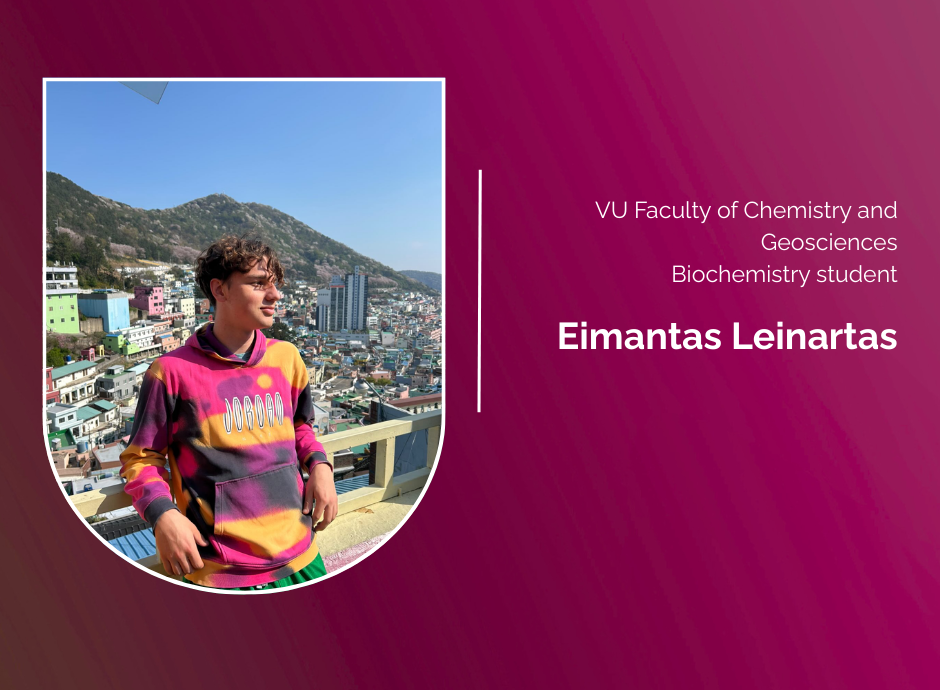
For students of the Faculty of Chemistry and Geosciences at Vilnius University who are planning to participate in the Erasmus+ exchange program, particularly at the University of Cordoba in Spain, the experience of former exchange student Eimantas Leinartas reveals unique academic opportunities as well as the challenges of adapting. We invite you to read the interview below.
Which university did you attend in Spain?
The University of Cordoba. At first, it seemed like a maze. The campus is very large and located far away, as it is not in the city. I had to take the train to get to my faculty.
However, lectures and seminars are held in the same way (as in Vilnius university). During the first week, I did not know the exact locations, so it was difficult to find the lecture halls. I had to ask everywhere: the administration, other people, students who had been studying there for a longer time, where to find everything. You naturally make friends from other cultures who, like you, are part of an international exchange program. By joining forces, we managed to find everything – of course, this took time.
What challenges did you face and how did you overcome them?
Number one, in my opinion, is the loneliness that overwhelms you at first. When you arrive in a new country, you have no friends from Lithuania or your parents by your side – you can not ask them or seek for advice. You feel like you have to do everything on your own.
Later on, it seems like organizations such as the Erasmus Student Network (ESN) and others specifically organized all these events so that international students can meet locals and form groups of friends. So, with time, I got used to it and everything fell into place.
In addition, I had to get used to the Spanish lifestyle because, for example, I did not know that shops are closed on Sundays here. I had to remember to buy everything I needed for Sunday on Saturday. I also had to get used to the siesta, when everything closes in the middle of the day, people go to rest, and then return to work in the evening.
Speaking of studies, how do you think this exchange will contribute to your future studies or even your future career?
I had some course such as a couple of veterinary classes, cytology and theology. Maybe they will come in handy. I did not have any biochemical engineering or information about it before. In Spain I had to study, for example, biotechnology, sterilization, filtration – that will definitely come in handy in the future.
I also had subjects such as the biology of atomic and molecular systems. There, I learned how to apply systems such as proteomics and metallomics, where DNA is used to explore the possibility of curing incurable diseases such as cancer, diabetes and even HIV.
I also had to study biochemistry and molecular biology. This course was easy, more about genetics. And that will also be needed in the future. I also noticed the main difference between Spanish and our exams. In our country, when a teacher creates, say, a multiple-choice test, if you do not know the answer, you can guess. The Spanish penalize you for guessing – if you do not guess correctly, they take away points from your score.
Speaking of socializing in Spain, I did not have any Spanish friends. My group of friends there was mainly international: Swiss, Dutch, a few Germans, Polish people. And me – the only Lithuanian here.
How would you rate the Erasmus+ program and the opportunity to study abroad in general?
The hardest part was definitely leaving. Of course, the coordinating organization Erasmus Student Network (ESN) organized seminars in advance and explained everything: what would happen next and what needed to be done.
I had some problems with accommodation, but in the end I managed to find something and was happy to leave. Anyway, speaking of feedback, I rate everything very positively, because I would once again confirm what other people who had already gone on Erasmus studies told me. Some said it was not the best experience for them, but others say it is one of the best periods of their lives. Me, I am happy, of course. There were moments when I did not feel my best (it happens to everyone), but in the end, I am happy with this experience.
What advice would you give to other students who are considering participating in the Erasmus+ exchange program? What advice or strategies would you give them, especially now that the exchange is coming to an end?
How can I put this... Actually, when the time came and I knew my flight was approaching, I felt very nervous. Especially if you are, so to speak, an introvert. If you are determined to socialize, you can quickly turn from an introvert into an extrovert. However, you definitely have to step out of your comfort zone and get to know other people.
And that is actually very easy to do because you are among international students. Everyone asks where you are from and so on. Eventually, you will get together and form a group (chat) of all of you.
But if you plan to go with only the purpose of studying (which is, of course, important), you should take into account that Erasmus+ offers other things as well. If, for example, you are a „loner“ who just studies, does not go anywhere, and sits in your room, then I think you will waste your time a little.
I would say this: if you have the opportunity, it is 100% worth registering. Of course, you have to study well in order to be selected by the commission.
After Erasmus in Spain, Eimantas went to South Korea: „The experience is truly invaluable, although at first it feels strange to be „far away“, but you get used to it over time. I am happy that VU offers study exchange opportunities and I encourage others not to be afraid to take part in it“ – Eimantas, a biochemistry student at VU FCHG, happily shares his experience.